
 EN
 AR
 HR
 DA
 NL
 FR
 DE
 EL
 HI
 IT
 JA
 KO
 NO
 PL
 PT
 RO
 RU
 ES
 TL
 IW
 ID
 SR
 SK
 UK
 VI
 TH
 TR
 AF
 MS
 IS
 HY
 AZ
 KA
 BN
 LA
 MR
 MY
 KK
 UZ
 KY
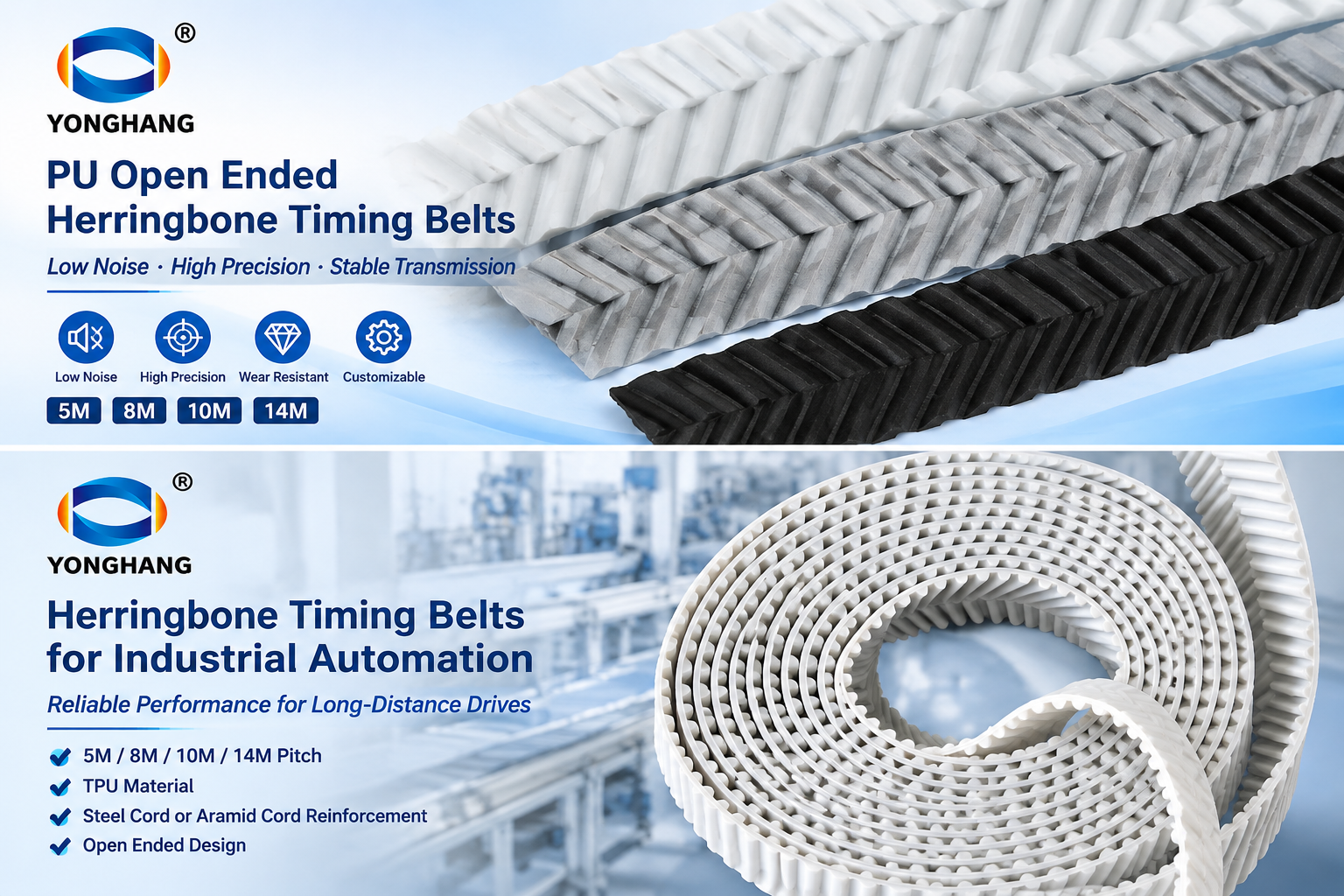
Selecting the correct timing belt is essential for building a reliable industrial transmission system. For equipment manufacturers working with long-distance drives, automated positioning mechanisms, or synchronized conveying systems, the belt's tooth profile, reinforcement, and dimensional specifications can directly influence machine performance.
One specialized solution worth considering is the Open Ended Herringbone Timing Belt, also known as a double helical synchronous belt.
Unlike conventional timing belts with straight transverse teeth, herringbone timing belts feature opposing angled tooth sections that form a distinctive chevron pattern. This design is intended to balance lateral forces during engagement and support stable belt tracking when used with a compatible pulley.
Yonghang supplies PU Open Ended Herringbone Timing Belts in four nominal pitch options: 5M, 8M, 10M, and 14M. These products use thermoplastic polyurethane construction and can be configured with continuous high-tensile steel or aramid cord reinforcement according to application requirements.
This guide explains how to select the appropriate herringbone timing belt for your machine and what technical information to prepare before requesting a quotation.
1. What Makes Open Ended Herringbone Timing Belts Different?
An open-ended herringbone timing belt combines three important structural characteristics.
Herringbone Tooth Geometry
The teeth feature two angled sections arranged in opposing directions.
This structure creates a symmetrical pattern designed to balance lateral force components during pulley engagement.
When paired with a matching pulley, the configuration can contribute to controlled belt tracking and smooth transmission.
Polyurethane Belt Body
The belt body is manufactured using thermoplastic polyurethane.
TPU is commonly selected for industrial timing belt production because of its abrasion resistance, flexibility, and mechanical durability.
The material is suitable for applications involving repeated bending and continuous transmission, provided the compound and reinforcement are correctly selected.
Continuous Open-Ended Structure
Unlike a fixed-length endless timing belt, an open-ended belt is supplied in continuous lengths.
This format is particularly useful for linear motion equipment, long-center-distance drives, and customized transmission layouts.
Together, these characteristics make open-ended herringbone timing belts suitable for evaluating in specialized industrial machinery.
2. Understanding the Four Available Pitch Options
Tooth pitch is one of the first specifications that should be checked when selecting a timing belt.
It refers to the distance between corresponding points on adjacent teeth.
Yonghang's open-ended herringbone timing belt collection includes four pitch options.
5M PU Open Ended Herringbone Timing Belt
The 5M configuration is the smallest pitch option in this product range.
It can be considered for compact transmission systems where the equipment is designed around a 5 mm herringbone tooth profile.
Potential considerations include:
-
Compact linear motion arrangements.
-
Smaller transmission pulley designs.
-
Specialized positioning mechanisms.
-
Equipment requiring a 5M double helical profile.
Product reference: 5M PU Open Ended Herringbone Timing Belt
8M PU Open Ended Herringbone Timing Belt
The 8M version provides a larger tooth spacing than the 5M configuration.
It is suitable for equipment specifically designed around an 8M herringbone transmission profile.
Before selection, buyers should confirm the tooth geometry and matching pulley dimensions rather than relying on pitch alone.
Product reference: 8M PU Open Ended Herringbone Timing Belt
10M PU Open Ended Herringbone Timing Belt
The 10M configuration is intended for machinery using a nominal 10 mm herringbone tooth pitch.
It can be considered for customized industrial drive systems, linear motion mechanisms, and specialized synchronized transmission arrangements.
The required belt width, reinforcement, and continuous length should be selected according to the machine design.
Product reference: 10M PU Open Ended Herringbone Timing Belt
14M PU Open Ended Herringbone Timing Belt
The 14M configuration is the largest pitch option currently listed in Yonghang's herringbone timing belt collection.
It can be evaluated for equipment designed around a larger-pitch transmission arrangement.
The final belt selection should consider the matching pulley, belt width, working tension, and required mechanical performance.
Product reference: 14M PU Open Ended Herringbone Timing Belt
Comparison of Available Herringbone Timing Belt Pitches
| Product | Tooth Pitch | Typical Selection Consideration |
|---|---|---|
| 5M PU Herringbone Belt | 5 mm | Compact transmission design |
| 8M PU Herringbone Belt | 8 mm | Intermediate pitch configuration |
| 10M PU Herringbone Belt | 10 mm | Specialized larger-pitch drive system |
| 14M PU Herringbone Belt | 14 mm | Larger-pitch transmission design |
Important: These descriptions are general selection considerations, not load ratings. A larger pitch does not automatically indicate a higher load capacity. The actual performance depends on the complete belt construction, width, reinforcement, pulley diameter, tension, and operating conditions.
3. Why Does Reinforcement Material Matter?
The internal tensile reinforcement is a key factor in the performance of an open-ended timing belt.
While polyurethane forms the belt body and tooth structure, the reinforcement helps maintain belt strength and dimensional stability under tension.
Yonghang's herringbone timing belt range offers continuous high-tensile steel or aramid cord reinforcement options, subject to the required specification.
Steel Cord Reinforcement
Steel cord is commonly used in industrial synchronous belts requiring good tensile strength and resistance to elongation.
Potential benefits include:
-
High tensile strength.
-
Good dimensional stability.
-
Resistance to elongation under suitable operating conditions.
-
Suitable characteristics for precision transmission systems.
Steel cord is worth considering when the equipment requires stable belt length and controlled movement under mechanical tension.
Aramid Cord Reinforcement
Aramid is a high-strength synthetic reinforcement material.
It provides a lightweight alternative to steel cord and can be considered for applications where the mechanical design benefits from lower reinforcement weight.
Potential characteristics include:
-
High strength-to-weight ratio.
-
Lightweight reinforcement.
-
Good tensile performance.
-
Suitability for specialized industrial transmission requirements.
The best option depends on the machine design, load, speed, installation geometry, and performance priorities.
Neither reinforcement should be selected by material name alone. The required construction should be evaluated for the actual application.
4. Why Do Manufacturers Choose Open-Ended Timing Belts?
An open-ended timing belt provides more flexibility than a standard endless belt when designing customized transmission systems.
Long-Center-Distance Drives
Some machines require transmission between components positioned relatively far apart.
Open-ended timing belts can be supplied in continuous lengths to accommodate these layouts.
Linear Motion Systems
Linear actuators and positioning mechanisms frequently rely on belt drives to move components along a defined path.
Open-ended construction can be integrated into different linear motion arrangements according to the equipment structure.
Customized Machine Design
Machine manufacturers may need belt lengths or dimensions that are not available in standard endless formats.
Continuous open-ended belts provide flexibility when determining the required installation length.
Specialized Synchronous Conveying
Certain conveying systems require synchronized movement between pulleys and moving components.
The herringbone tooth profile can be considered where the equipment incorporates a compatible pulley structure.
5. How Does a Herringbone Tooth Profile Support Stable Operation?
The most recognizable characteristic of a herringbone timing belt is its double helical tooth arrangement.
The opposing angled sections are designed to balance lateral force components during engagement.
This structure can offer several benefits when the belt is incorporated into a correctly engineered system.
Stable engagement: The angled teeth engage with a matching herringbone pulley to transmit mechanical movement.
Balanced lateral forces: Opposing tooth directions help balance lateral force components generated during operation.
Controlled tracking: The tooth geometry can contribute to stable belt movement when the pulley and installation arrangement are properly designed.
Smooth meshing: The angled tooth arrangement provides a progressive engagement geometry that can help reduce engagement impact and operating noise.
Actual noise and tracking performance depend on belt speed, load, pulley quality, tension, alignment, and the overall machine design.
It is important to remember that the herringbone profile is not interchangeable with a conventional straight-tooth timing belt profile.
6. Industrial Applications of Open Ended Herringbone Timing Belts
PU open-ended herringbone timing belts can be evaluated for several industrial sectors.
Automated Linear Positioning
Automated positioning equipment often requires controlled movement over a defined travel distance.
The open-ended belt format provides flexibility in designing the transmission length and layout.
Industrial Conveying Systems
Synchronous conveying mechanisms may require accurate coordination between the belt drive and moving components.
The herringbone profile can be considered when the equipment is designed around a corresponding pulley.
Packaging and Production Machinery
Modern production equipment often requires repeatable feeding, positioning, and mechanical synchronization.
Customized open-ended timing belts provide another option for integrating belt drives into specialized machinery.
CNC and Mechanical Automation
Certain CNC-related systems and mechanical automation devices use belt-driven components for controlled movement.
The required belt pitch, length, and reinforcement must be selected according to the machine's design.
Customized Industrial Equipment
Special-purpose machinery often requires unique transmission dimensions and configurations.
Yonghang welcomes technical inquiries for customized PU herringbone timing belts for these applications.
7. A Practical Checklist Before Ordering
Before purchasing an open-ended herringbone timing belt, prepare the following information.
| Technical Information | Why It Matters |
|---|---|
| Tooth pitch | Determines the basic belt and pulley pitch compatibility |
| Herringbone tooth profile | Confirms the correct engagement geometry |
| Belt width | Determines compatibility with the pulley and installation space |
| Open-ended length | Defines the continuous belt supply requirement |
| Reinforcement material | Influences tensile performance and dimensional stability |
| Pulley specifications | Helps verify belt compatibility |
| Operating speed | Helps determine the appropriate transmission design |
| Working load | Helps evaluate belt construction requirements |
| Environmental conditions | Helps determine material suitability |
If you are replacing an existing belt, sending a physical sample or clear photographs can be especially helpful.
For new equipment projects, a technical drawing showing the pulley layout and installation dimensions is recommended.
8. Common Mistakes When Selecting a Herringbone Timing Belt
Even experienced buyers can overlook important details when ordering specialized timing belts.
Here are several points worth checking.
Choosing Only by Pitch
A 10M herringbone belt and a conventional 10M straight-tooth timing belt do not necessarily have interchangeable tooth profiles.
Always confirm the actual pulley design.
Ignoring Reinforcement Requirements
The correct reinforcement is important for maintaining belt dimensions under operating tension.
Steel cord and aramid cord should be evaluated according to the mechanical application.
Ordering the Wrong Length
Open-ended belts are supplied in continuous lengths, so it is important to confirm the required installation length and measurement method.
Overlooking the Operating Environment
Temperature, oil exposure, dust, moisture, and other environmental factors may influence material selection and service performance.
Providing Incomplete Product Information
A product name alone may not contain enough information to identify the correct configuration.
Drawings, original samples, and pulley specifications can help reduce ordering errors.
9. Customized PU Herringbone Timing Belts from Yonghang
Yonghang specializes in transmission belts for industrial machinery and customized equipment applications.
Our open-ended herringbone timing belt collection includes:
-
5M PU Open Ended Herringbone Timing Belt.
-
8M PU Open Ended Herringbone Timing Belt.
-
10M PU Open Ended Herringbone Timing Belt.
-
14M PU Open Ended Herringbone Timing Belt.
Steel cord and aramid cord reinforcement options can be discussed according to project requirements.
Customers can submit belt drawings, technical specifications, pulley samples, or existing belt photographs for evaluation.
Whether you are developing a new automation machine or replacing an existing transmission belt, our team welcomes your inquiry.
Frequently Asked Questions
Q1: What is an open-ended herringbone timing belt?
It is a continuous-length synchronous belt featuring a double helical or chevron tooth arrangement. It is designed for compatible drive systems requiring customized transmission lengths.
Q2: What pitch options are available from Yonghang?
Yonghang's product category lists 5M, 8M, 10M, and 14M PU open-ended herringbone timing belts.
Q3: What materials are used in these belts?
The belt body is manufactured from thermoplastic polyurethane (TPU), with continuous high-tensile steel or aramid cord reinforcement options according to the product configuration.
Q4: What is the advantage of a herringbone tooth profile?
The opposing angled tooth arrangement is designed to balance lateral force components during engagement and support stable belt movement with a compatible pulley.
Q5: Can open-ended herringbone timing belts be customized?
Yes. Belt width, continuous supply length, reinforcement options, and other technical specifications can be discussed according to the machine design.
Q6: Are herringbone timing belts suitable for long-distance linear motion?
They can be considered for long-center-distance drive systems and linear motion equipment designed around the corresponding tooth profile and pulley configuration.
Q7: Can a herringbone belt replace a standard straight-tooth timing belt?
Not automatically. The tooth geometry and pulley design must be compatible. A herringbone belt should be selected for a transmission system designed for this profile.
Conclusion: Find the Right PU Herringbone Timing Belt for Your Machine
Choosing the right open-ended herringbone timing belt involves more than identifying a 5M, 8M, 10M, or 14M pitch.
To achieve reliable transmission performance, equipment manufacturers must also consider tooth geometry, belt width, continuous length, tensile reinforcement, pulley compatibility, and operating conditions.
Yonghang provides PU Open Ended Herringbone Timing Belts with multiple pitch options and steel or aramid cord reinforcement configurations for specialized industrial requirements.
Contact Yonghang with your technical drawing, original belt sample, or equipment specifications to discuss a suitable polyurethane herringbone timing belt for your application.
Table of Contents
- 1. What Makes Open Ended Herringbone Timing Belts Different?
- 2. Understanding the Four Available Pitch Options
- 3. Why Does Reinforcement Material Matter?
- 4. Why Do Manufacturers Choose Open-Ended Timing Belts?
- 5. How Does a Herringbone Tooth Profile Support Stable Operation?
- 6. Industrial Applications of Open Ended Herringbone Timing Belts
- 7. A Practical Checklist Before Ordering
- 8. Common Mistakes When Selecting a Herringbone Timing Belt
- 9. Customized PU Herringbone Timing Belts from Yonghang
-
Frequently Asked Questions
- Q1: What is an open-ended herringbone timing belt?
- Q2: What pitch options are available from Yonghang?
- Q3: What materials are used in these belts?
- Q4: What is the advantage of a herringbone tooth profile?
- Q5: Can open-ended herringbone timing belts be customized?
- Q6: Are herringbone timing belts suitable for long-distance linear motion?
- Q7: Can a herringbone belt replace a standard straight-tooth timing belt?
- Conclusion: Find the Right PU Herringbone Timing Belt for Your Machine