EN
 AR
 HR
 DA
 NL
 FR
 DE
 EL
 HI
 IT
 JA
 KO
 NO
 PL
 PT
 RO
 RU
 ES
 TL
 IW
 ID
 SR
 SK
 UK
 VI
 TH
 TR
 AF
 MS
 IS
 HY
 AZ
 KA
 BN
 LA
 MR
 MY
 KK
 UZ
 KY
- Introduction
Introduction
Product Overview
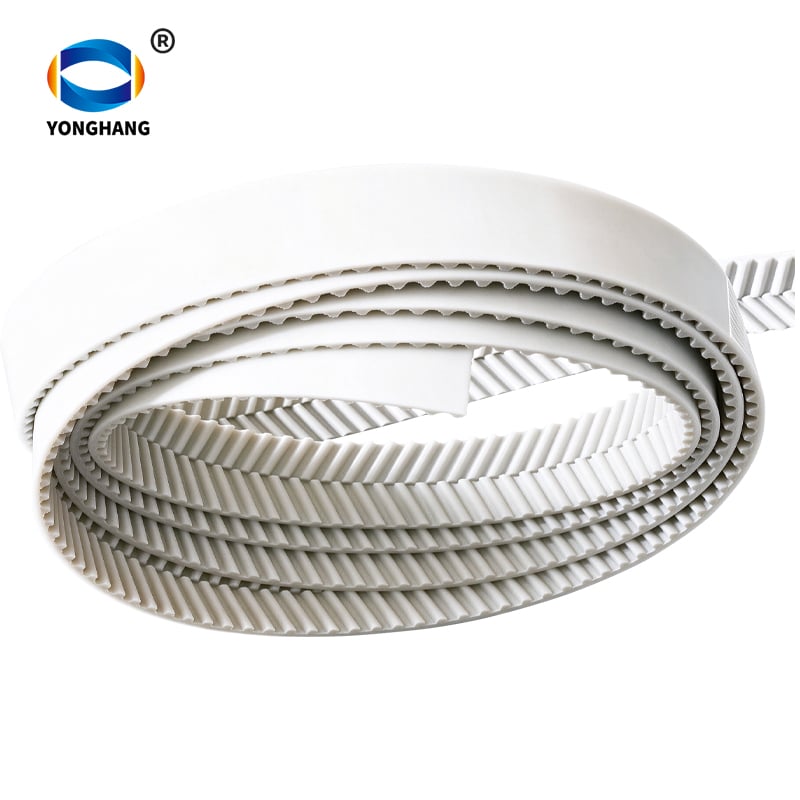
The 14M PU Open Ended Herringbone Timing Belt is a specialized polyurethane transmission belt developed for industrial drive systems, heavy-duty automation equipment, and customized linear motion applications. Combining a large-pitch timing belt structure with a distinctive herringbone tooth profile, this product is designed for machinery that requires synchronized movement, reliable power transmission, and controlled belt operation.
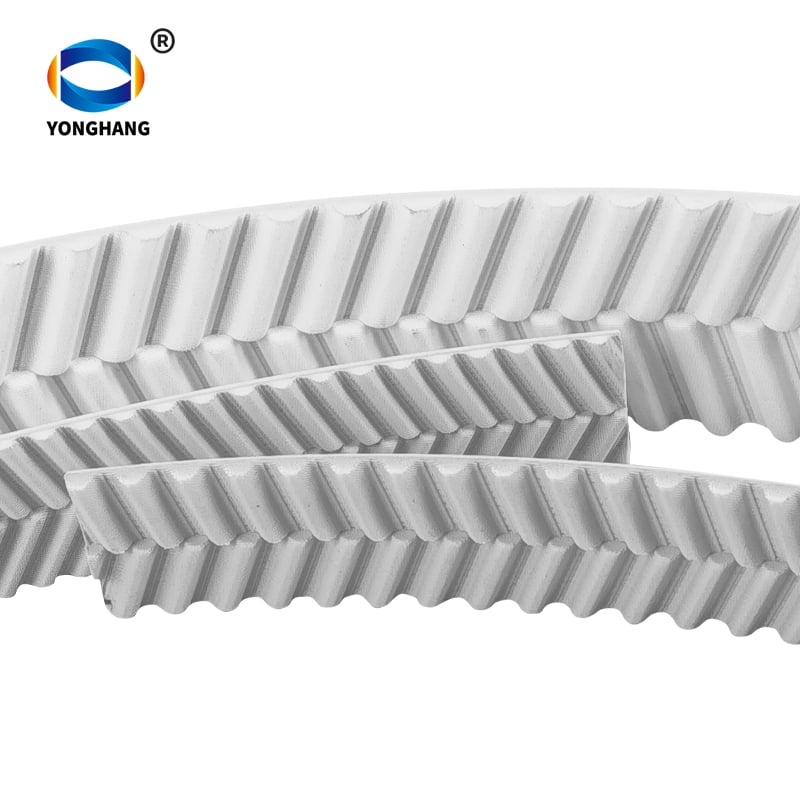
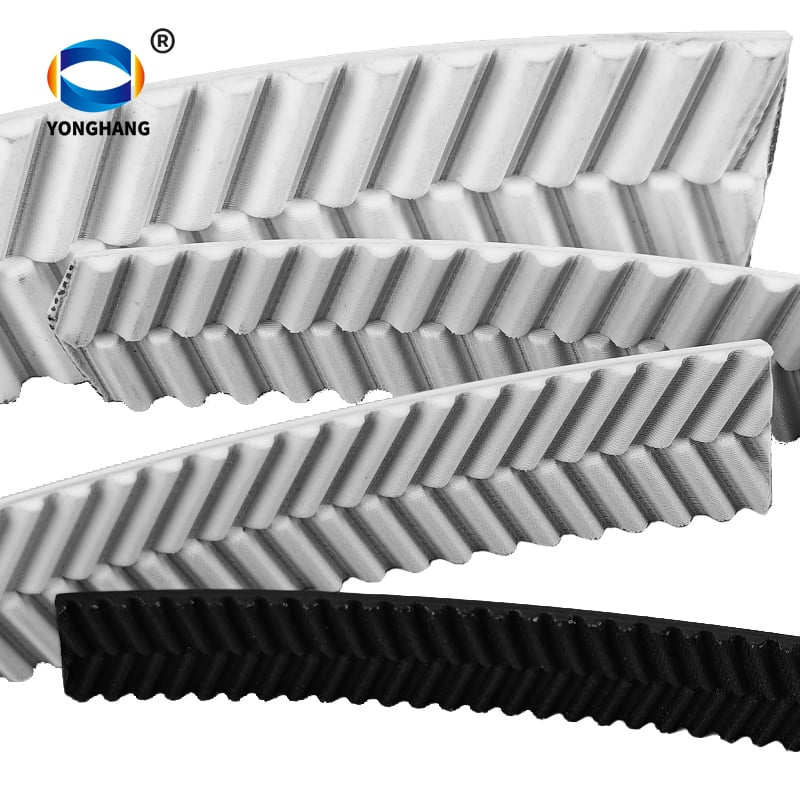
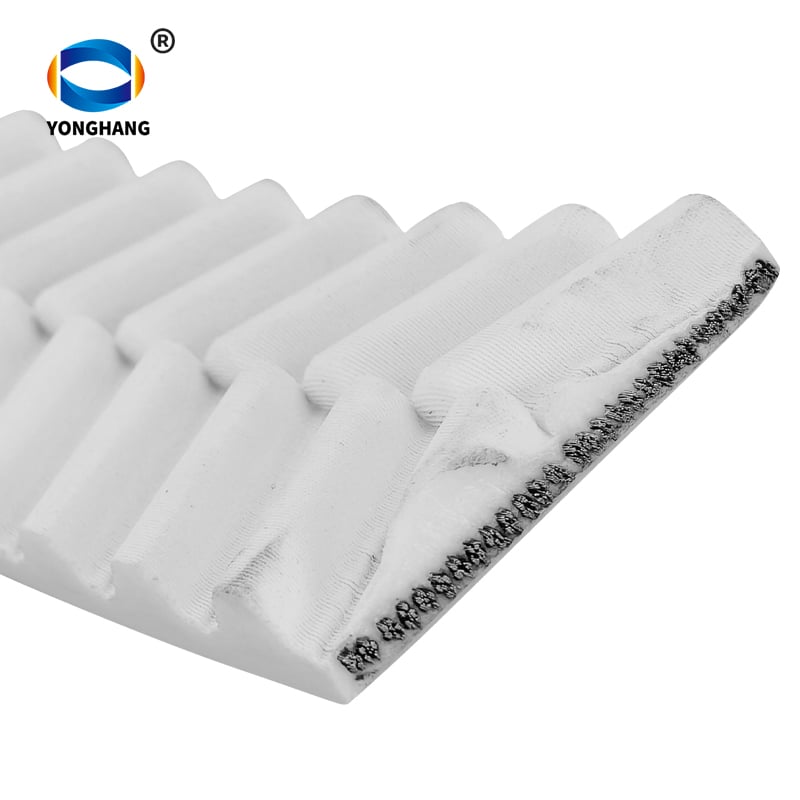
Manufactured from polyurethane (PU), the belt is suitable for industrial applications where wear resistance, dimensional stability, and mechanical durability are important. Its herringbone tooth design features two opposing angled tooth sections arranged in a symmetrical chevron pattern. This special geometry helps balance lateral force components generated during tooth engagement and can contribute to stable running when used with a correctly designed matching pulley.
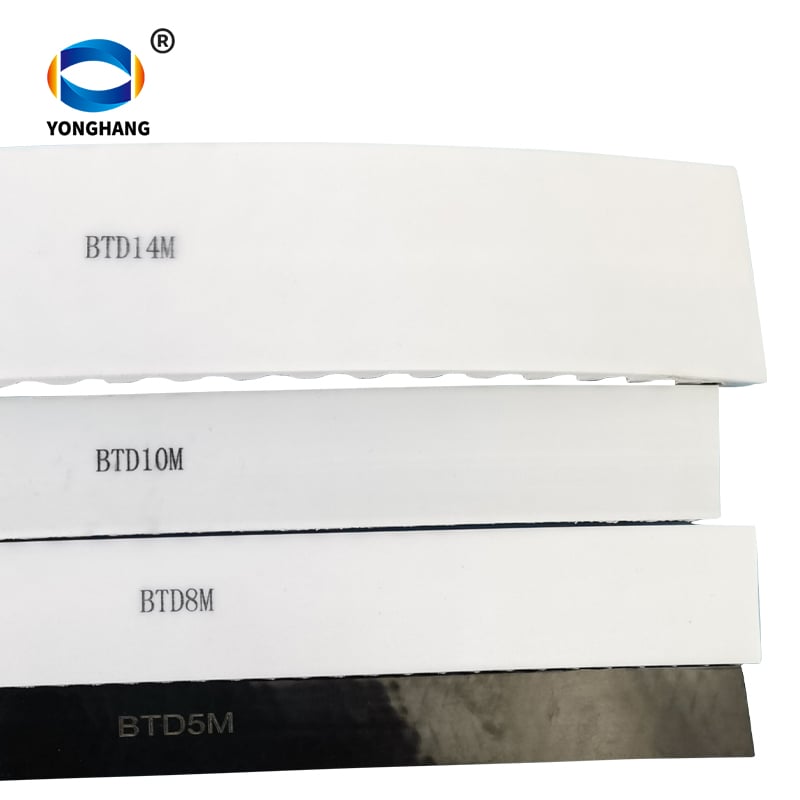
The 14M designation refers to a nominal tooth pitch of 14 mm. Compared with smaller-pitch timing belt configurations, the 14M profile is intended for transmission systems designed around a larger tooth spacing and corresponding pulley geometry.
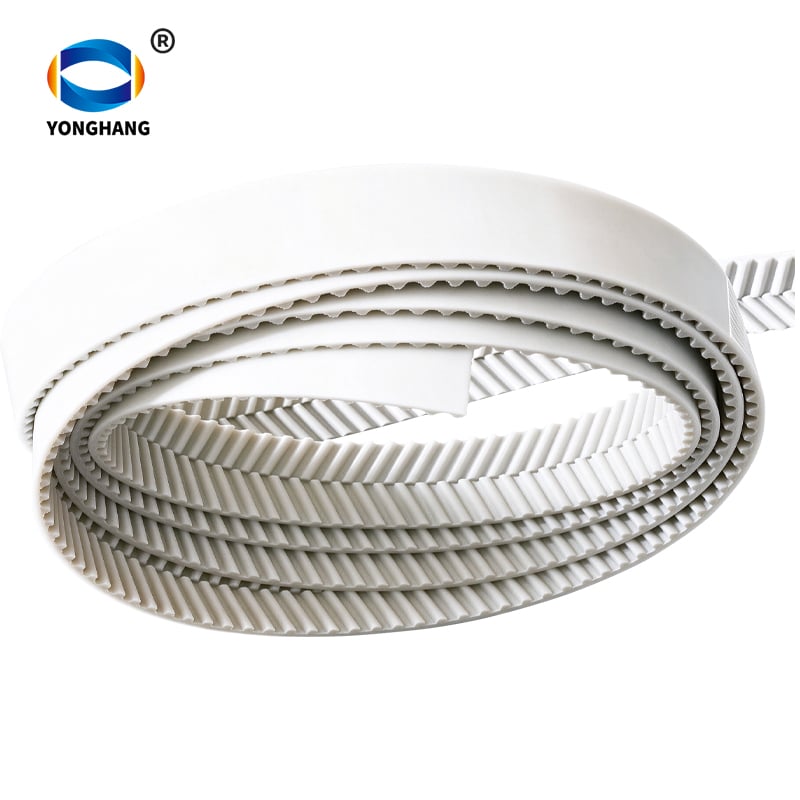
Unlike conventional endless timing belts, this product is supplied in an open-ended format. The continuous belt length can be selected according to the machine's transmission layout, making it suitable for customized equipment, long-distance linear drives, and specialized mechanical systems.
Yonghang provides polyurethane timing belt solutions for different industrial requirements. Belt width, supply length, reinforcement construction, and other customized specifications can be discussed according to technical drawings, original samples, and equipment information.
Key Features of 14M PU Open Ended Herringbone Timing Belt
1. Large 14M Tooth Pitch
This timing belt features a nominal 14 mm tooth pitch, designed for machinery equipped with a compatible 14M herringbone pulley system.
The larger pitch is suitable for transmission designs that require a different tooth geometry from smaller-pitch belt systems. Correct matching between the belt and pulley is essential for proper tooth engagement and reliable operation.
2. Special Herringbone Tooth Configuration
The defining feature of this product is its symmetrical herringbone tooth arrangement.
Two angled tooth sections extend in opposing directions to create a chevron-shaped profile. This configuration is designed to help balance lateral forces during transmission and can improve tracking behavior when the belt is correctly matched with the pulley.
The actual tracking performance depends on the tooth geometry, pulley design, alignment, and operating tension.
3. Polyurethane Material
The belt is made from polyurethane, a commonly used material for industrial timing belt manufacturing.
Its material characteristics include:
Good resistance to surface abrasion.
Flexibility for repeated bending around pulleys.
Mechanical durability under suitable working conditions.
Resistance to many commonly encountered industrial oils and greases, depending on the PU formulation.
Good dimensional characteristics when manufactured and installed correctly.
The specific performance depends on the selected polyurethane compound and reinforcement structure.
4. Open-Ended Construction
The open-ended design provides flexibility when determining the required belt length.
Instead of being restricted to a fixed endless circumference, the belt can be supplied in continuous lengths and cut to suit the installation requirements.
This format is particularly useful for machinery with long transmission paths, customized linear motion arrangements, and special mechanical layouts.
5. Customized Manufacturing Options
Different machines require different belt dimensions and mechanical properties.
Yonghang can discuss customized specifications according to individual project requirements, including belt width, supply length, reinforcement materials, and special processing options.
Customers can submit drawings, samples, or detailed measurements to help identify a suitable configuration.
14M PU Herringbone Timing Belt Specifications
| Item | Specification |
|---|---|
| Product Name | 14M PU Open Ended Herringbone Timing Belt |
| Belt Material | Polyurethane (PU) |
| Belt Type | Open-Ended Timing Belt |
| Tooth Pitch | 14 mm |
| Tooth Profile | Herringbone / Chevron |
| Tooth Arrangement | Opposing angled tooth sections |
| Supply Form | Continuous open length |
| Belt Width | Customizable |
| Belt Length | Customizable |
| Tensile Reinforcement | To be confirmed according to requirements |
| Color | To be confirmed |
| Custom Processing | Available upon technical confirmation |
| Main Applications | Industrial machinery, automation, and linear motion systems |
Technical Information: The 14M designation identifies the nominal tooth pitch. The exact tooth dimensions, belt thickness, reinforcement construction, available widths, and other manufacturing parameters should be confirmed according to the actual product drawing.
How Does a 14M Herringbone Timing Belt Work?
A timing belt transfers mechanical movement through the engagement between its teeth and the corresponding grooves of a pulley.
In a standard timing belt, the teeth are generally arranged perpendicular to the belt's running direction. A herringbone timing belt uses two opposing angled tooth sections that form a continuous symmetrical pattern.
This tooth configuration creates a different engagement geometry and influences the distribution of forces between the belt and pulley.
The working characteristics include:
Synchronized Power Transmission
The belt engages with its matching timing pulley to transfer movement according to the designed transmission ratio.
Balanced Lateral Force Components
The opposing tooth directions are designed to balance lateral force components generated during engagement. This can help support stable belt tracking in a properly engineered system.
Consistent Mechanical Movement
When the belt profile, pulley geometry, and installation conditions are correctly matched, the system can deliver controlled and repeatable transmission.
Flexible Length Configuration
The open-ended design allows manufacturers to select the required belt length for different equipment layouts without being limited to a standard endless belt circumference.
For correct operation, the belt must be paired with a compatible 14M herringbone pulley. A conventional straight-tooth 14M pulley should not be assumed to fit this special tooth configuration.
Applications of 14M PU Open Ended Herringbone Timing Belts
The 14M PU Open Ended Herringbone Timing Belt can be considered for specialized industrial machinery that requires a larger-pitch synchronous transmission system.
1. Heavy-Duty Linear Drive Systems
Some linear motion mechanisms require long transmission distances and specific belt configurations.
The 14M open-ended design can be evaluated for these systems, particularly where the machine uses a compatible herringbone pulley arrangement.
2. Industrial Automation Machinery
Automated production equipment often relies on synchronized mechanical movement to coordinate multiple working stations.
A customized 14M PU herringbone belt can be incorporated into suitable drive mechanisms where the tooth profile and mechanical dimensions meet the machine requirements.
3. Large-Format Mechanical Equipment
Equipment with larger mechanical layouts may require timing belts with different pitch and width specifications.
The 14M profile provides another option for machinery specifically designed around larger-pitch herringbone transmission components.
4. CNC and Positioning Equipment
Certain CNC-related machines and positioning systems use belt-driven mechanisms to control the movement of mechanical assemblies.
A 14M herringbone timing belt may be considered where the equipment requires a matching profile and customized open-ended belt length.
5. Customized Material Handling Systems
Industrial material handling equipment may require specialized belt transmission arrangements for controlled movement and synchronization.
The open-ended configuration provides flexibility when designing long-distance drive systems and customized machinery.
6. Special-Purpose Machinery
Machine manufacturers sometimes develop equipment with non-standard transmission structures. For these projects, customized herringbone timing belts can be evaluated according to the required tooth geometry, installation dimensions, and operating conditions.
Final application suitability should always be confirmed against the actual machine design.
14M Herringbone Timing Belt vs. Conventional 14M Timing Belt
Although both belt types have a nominal 14 mm tooth pitch, their tooth profiles and pulley requirements are different.
| Comparison | Conventional 14M Timing Belt | 14M Herringbone Timing Belt |
|---|---|---|
| Nominal Tooth Pitch | 14 mm | 14 mm |
| Tooth Arrangement | Straight transverse teeth | Opposing angled teeth |
| Tooth Geometry | Conventional profile | Symmetrical chevron profile |
| Pulley Compatibility | Matching standard 14M pulley | Matching 14M herringbone pulley |
| Transmission Characteristics | Conventional synchronous engagement | Specialized angled-tooth engagement |
| Tracking Behavior | Depends on the complete drive design | Designed to balance lateral force components |
| Main Application | General synchronous drives | Specialized transmission systems |
The most important selection factor is the matching tooth geometry. Sharing the same nominal pitch does not make the two belt designs interchangeable.
Advantages of Open-Ended PU Herringbone Timing Belts
Open-ended timing belts offer several practical benefits for equipment manufacturers and mechanical system designers.
Flexible Length Selection
The belt can be supplied in continuous lengths to accommodate different transmission distances.
Convenient Integration into Custom Machinery
The open-ended construction is suitable for equipment where a fixed endless belt is not the preferred installation format.
Specialized Tooth Geometry
The herringbone profile provides an alternative transmission design for machines equipped with compatible pulleys.
Polyurethane Belt Material
PU offers a useful combination of flexibility, wear resistance, and mechanical properties for industrial belt applications.
Multiple Customization Possibilities
Belt width, length, reinforcement structure, and other technical requirements can be reviewed according to the project.
Why Choose Yonghang 14M PU Open Ended Herringbone Timing Belt?
Yonghang specializes in industrial transmission belts and customized timing belt solutions. We understand that different machinery designs require different belt dimensions, tooth configurations, and reinforcement specifications.
For customers sourcing 14M PU Open Ended Herringbone Timing Belts, Yonghang provides the opportunity to discuss product requirements based on actual equipment conditions.
Customized belt dimensions: Belt width and open-ended supply length can be discussed according to your requirements.
Specialized herringbone profile: Designed for transmission systems requiring a compatible chevron tooth arrangement.
Polyurethane construction: Suitable for industrial applications requiring abrasion resistance and mechanical flexibility.
Flexible project support: Technical drawings, original belt samples, and pulley information can be used for specification review.
Industrial B2B supply: Suitable for machinery manufacturers, automation companies, distributors, and maintenance suppliers.
Our objective is to help customers identify an appropriate polyurethane timing belt configuration for their transmission equipment.
How to Select the Correct 14M PU Herringbone Timing Belt
Before purchasing, it is important to verify the following technical details.
1. Confirm the 14M Tooth Pitch
Ensure that the original equipment requires a nominal 14 mm tooth pitch.
2. Verify the Herringbone Tooth Profile
The tooth profile must match the pulley design. Please provide a drawing or photograph of the original belt and pulley if the exact profile is unknown.
3. Determine the Belt Width
The required belt width should be compatible with the pulley face and the installation space of the machine.
4. Confirm the Required Open-Ended Length
Measure the belt length required by the transmission layout. For customized installations, providing a dimensional drawing is recommended.
5. Select the Reinforcement Construction
The tensile reinforcement influences the belt's resistance to elongation and dimensional stability. Its material and construction should be selected according to the actual operating load and machine requirements.
6. Evaluate Operating Conditions
Consider operating temperature, belt speed, tension, humidity, oil exposure, and other environmental factors before selecting the final specification.
7. Provide a Sample or Technical Drawing
Providing an existing belt sample, pulley information, or technical drawing helps reduce the possibility of incorrect specifications.
Frequently Asked Questions
Q1: What does 14M mean in a PU herringbone timing belt?
14M represents a nominal tooth pitch of 14 mm. It identifies the distance between corresponding points on adjacent belt teeth.
Q2: What is the difference between a 14M herringbone timing belt and a regular 14M timing belt?
A regular 14M timing belt generally has straight transverse teeth, while a herringbone timing belt features two opposing angled tooth sections that form a chevron pattern. The different tooth geometry requires a compatible pulley design.
Q3: What material is used in the 14M open-ended herringbone timing belt?
The product is made from polyurethane (PU), a material commonly used for industrial timing belts because of its abrasion resistance, flexibility, and mechanical properties.
Q4: Can the 14M PU open-ended belt be supplied in customized lengths?
Yes. The belt is supplied in open-ended form, and the required continuous length can be discussed according to the equipment's installation requirements.
Q5: Can the belt width be customized?
Customized belt width requirements can be discussed. Please provide the desired dimensions, pulley specifications, or a technical drawing for evaluation.
Q6: Can this belt work with a conventional 14M timing pulley?
Not necessarily. The herringbone tooth structure differs from a conventional straight-tooth profile. A compatible herringbone pulley is required for proper engagement.
Q7: Can the open-ended belt be made into an endless belt?
Depending on the specific belt construction, polyurethane open-ended timing belts may be joined using a suitable welding process. For herringbone belts, tooth alignment and joint strength must be carefully evaluated before processing.
Q8: What information should I provide when requesting a quotation?
Please provide the required belt width, length, tooth profile, reinforcement requirements, pulley information, intended application, and order quantity. Technical drawings and original samples are particularly helpful.
Request a Quote for 14M PU Open Ended Herringbone Timing Belts
Are you looking for a customized 14M PU Open Ended Herringbone Timing Belt for your industrial machinery or automated transmission system?
Yonghang welcomes inquiries from equipment manufacturers, industrial distributors, automation integrators, and maintenance companies.
To help us understand your requirements, please provide:
Required belt width.
Required open-ended belt length.
14M herringbone tooth profile specifications.
Reinforcement material requirements.
Matching pulley details.
Machine model and application.
Estimated purchase quantity.
You can also send us your original belt sample, product photographs, or technical drawings for reference.
Product: 14M PU Open Ended Herringbone Timing Belt
Material: Polyurethane (PU)
Tooth Pitch: 14 mm
Tooth Profile: Herringbone / Chevron
Supply Type: Open-Ended
Customization: Available according to technical requirements
Contact Yonghang today to discuss your customized 14M polyurethane herringbone timing belt requirements.