
 EN
 AR
 HR
 DA
 NL
 FR
 DE
 EL
 HI
 IT
 JA
 KO
 NO
 PL
 PT
 RO
 RU
 ES
 TL
 IW
 ID
 SR
 SK
 UK
 VI
 TH
 TR
 AF
 MS
 IS
 HY
 AZ
 KA
 BN
 LA
 MR
 MY
 KK
 UZ
 KY
Introduction
Vertical wall-climbing robots are designed to move across surfaces that conventional wheeled or tracked machines cannot easily access. They are used in applications such as steel structure inspection, industrial maintenance, surface cleaning, and specialized inspection of metal equipment. For these robots, the movement system must provide controlled traction while helping the machine remain attached to a vertical surface.
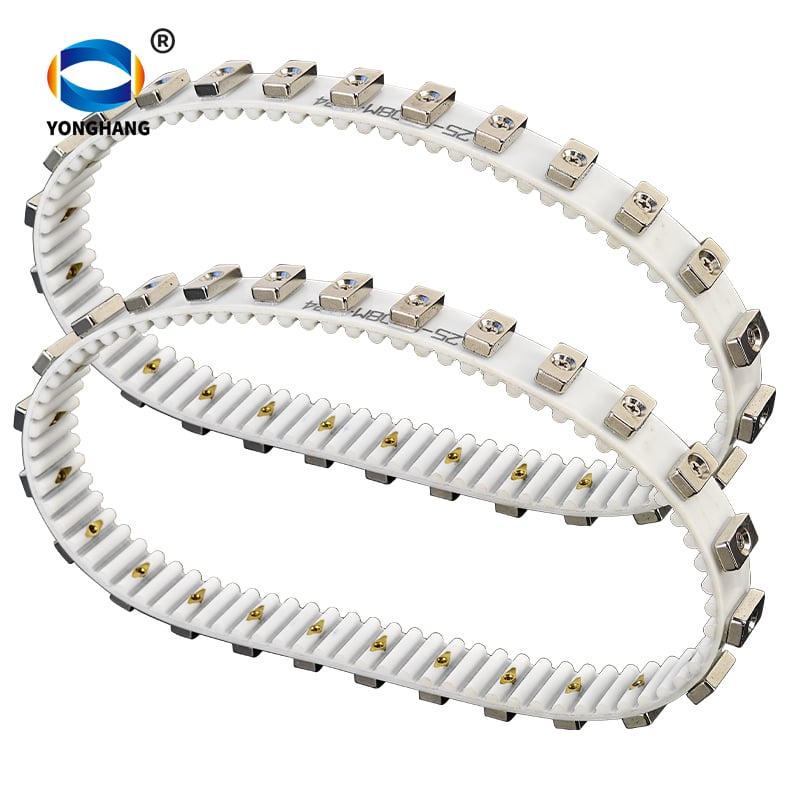
A PU timing belt with exposed magnetic blocks offers a specialized solution for wall-climbing equipment designed to operate on suitable ferromagnetic surfaces. This belt combines the synchronized transmission structure of a polyurethane timing belt with external magnetic blocks that provide magnetic attraction to compatible metal surfaces.
Unlike a conventional timing belt used only to transfer motion, this configuration brings two functions into one belt assembly: mechanical transmission and magnetic surface attachment. The timing belt works with the robot's drive mechanism, while the magnetic blocks help the robot maintain contact with a suitable steel surface.
For robot manufacturers and automation engineers, understanding the belt structure, magnetic requirements, and operating conditions is essential when selecting a suitable track or drive component.
What Is a PU Timing Belt with Exposed Magnetic Blocks?
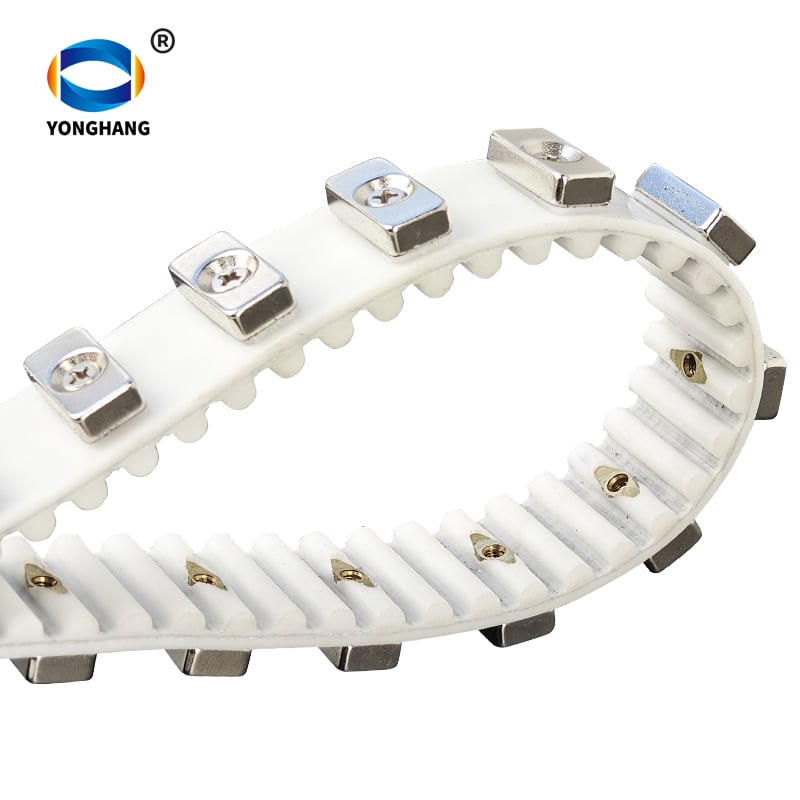
A PU timing belt with exposed magnetic blocks is a customized transmission belt featuring magnetic components mounted on its outer surface. The belt body is made from polyurethane (PU), and the inner toothed profile engages with a compatible timing pulley to transmit motion.
In the exposed-block design, the magnetic components remain visible on the outside of the belt rather than being completely enclosed within the belt body. Depending on the machine design, these blocks can provide magnetic attraction between the moving belt and a compatible metal surface.
The assembly generally serves three important purposes:
-
Synchronized movement: The toothed belt engages with its matching pulley to support controlled, repeatable motion.
-
Magnetic attachment: The external magnetic blocks attract suitable ferromagnetic surfaces, helping the robot remain attached while moving vertically.
-
Integrated mechanical design: The belt and magnetic components work together as part of the robot's movement and attachment system.
The exact performance depends on the belt dimensions, tooth profile, magnetic block arrangement, magnet specifications, and the design of the complete robotic mechanism.
How Does a Magnetic Timing Belt Work on a Vertical Wall-Climbing Robot?
A magnetic wall-climbing robot must address two requirements: it needs to move along a surface, and it must generate sufficient attraction to resist separation from that surface.
A PU timing belt with exposed magnetic blocks contributes to both functions through its combined mechanical and magnetic structure.
1. The Timing Belt Transmits Motion
The robot's drive motor rotates a compatible pulley. The pulley engages with the belt teeth, moving the belt along its designated path. This toothed engagement helps maintain synchronization between the drive components when the belt and pulley are correctly matched.
For a wall-climbing robot, consistent belt movement is important for controlled travel and maneuvering.
2. The Magnetic Blocks Attract the Metal Surface
As the belt travels, the external magnetic blocks move with it. When positioned near a suitable ferromagnetic surface, such as a compatible steel panel, the magnets generate an attractive force.
This magnetic attraction helps keep the belt assembly in contact with the surface. The robot's overall ability to climb depends on the magnetic configuration, robot weight, drive traction, surface condition, and mechanical design.
Important: Magnetic attachment is generally relevant to suitable ferromagnetic surfaces. It should not be assumed to work on ordinary concrete, glass, wood, aluminum, or other non-ferromagnetic surfaces without a different attachment mechanism.
3. The Robot Moves While Maintaining Contact
When the drive system operates, the belt moves around the robot's pulleys while the magnetic blocks provide attraction at the contact area. The robot's chassis, track arrangement, and control system determine how the machine travels, turns, and manages its load.
The belt is therefore one component of a larger wall-climbing system. Selecting the correct belt is important, but the robot must also be designed to provide adequate adhesion, traction, stability, and safety.
Why Use Polyurethane Timing Belts for Magnetic Wall-Climbing Robots?
Polyurethane is widely used in industrial timing belts because it offers a useful combination of mechanical properties for precision transmission applications. Its suitability for any particular wall-climbing robot still depends on the belt construction and operating requirements.
Wear Resistance for Repeated Movement
The belt may undergo repeated bending and contact as the robot travels across a surface. A properly specified PU timing belt can support repeated operation, although actual service life depends on the belt design, applied load, pulley configuration, and operating environment.
Positive Tooth Engagement
The toothed inner surface engages with a compatible pulley, supporting synchronized drive operation. Correct tooth profile and pitch are essential because an incompatible belt and pulley combination can cause poor engagement or premature wear.
A Base for Customized Magnetic Components
A PU timing belt can be configured with external magnetic blocks to meet specific mechanical requirements. The number, spacing, mounting method, and dimensions of the blocks should be determined according to the robot design rather than selected solely by appearance.
Flexibility in Belt Configuration
Different wall-climbing robots may require different belt widths, lengths, tooth profiles, and magnetic arrangements. Customization can help align the belt assembly with a particular drive mechanism and mounting structure.
Applications of Exposed Magnetic Block PU Timing Belts
Magnetic timing belts may be considered for robotic equipment designed to operate on compatible metal surfaces. Potential applications include the following.
Steel Structure Inspection Robots
Large steel structures may contain vertical or inclined surfaces that are difficult to inspect using conventional equipment. A magnetic wall-climbing robot can carry appropriate inspection sensors while moving across a compatible steel structure.
The magnetic belt configuration can form part of the robot's surface attachment and movement system.
Industrial Tank and Steel Panel Inspection
Some industrial tanks and metal enclosures require regular inspection of their external surfaces. Where the surface material and geometry are suitable, magnetic climbing robots may provide an alternative to manual access methods or conventional mobile platforms.
The robot designer must account for curvature, seams, coatings, surface contamination, and other conditions that can affect magnetic attraction and movement.
Ship Hull and Marine Steel Structure Inspection
Magnetic climbing robots may be developed for inspection or maintenance tasks on compatible ferromagnetic ship structures. The specific belt and magnet arrangement must be evaluated for the surface coating, corrosion condition, geometry, and environmental exposure.
Marine applications also require careful consideration of moisture, corrosion protection, and the compatibility of all exposed components.
Industrial Surface Cleaning and Maintenance
Depending on the robot's overall design, magnetic wall-climbing platforms may carry cleaning or maintenance tools for suitable metal surfaces. The additional forces produced by the tooling must be considered when determining the required adhesion and drive traction.
These are potential application areas rather than a guarantee that one belt design will suit every robot. The final configuration must be validated for the target surface and operating conditions.
Key Factors When Selecting a Magnetic Timing Belt for a Wall-Climbing Robot
Choosing a suitable belt involves more than matching its external dimensions. The mechanical transmission requirements and magnetic attachment requirements must be considered together.
1. Timing Belt Tooth Profile and Pitch
The belt tooth profile must match the pulley used in the robot's drive mechanism. Before ordering, identify the belt series, tooth pitch, tooth profile, and pulley specifications.
An incorrect tooth profile can affect engagement, transmission performance, and belt life.
2. Belt Width and Length
The belt dimensions must suit the robot's track layout, pulley arrangement, and available installation space. Buyers should confirm the required width, overall length, and dimensional measurement method.
For customized applications, a technical drawing or original belt sample is often more useful than a general product name.
3. Magnetic Block Quantity and Spacing
The distribution of magnetic blocks affects how magnetic attraction is applied along the belt. Their spacing, dimensions, and orientation should be designed according to the robot's contact geometry and expected movement.
Too little magnetic attraction may be insufficient for stable attachment. However, increasing magnetic attraction without considering the drive system can also affect movement resistance and energy requirements. The complete assembly must be evaluated as a system.
4. Magnetic Holding Force
The required magnetic force depends on several factors, including:
-
The robot's weight and payload.
-
The type and thickness of the target steel surface.
-
The distance between the magnetic blocks and the metal surface.
-
Surface coatings, rust, dirt, curvature, and unevenness.
-
The required safety margin during movement and tool operation.
A magnet's published holding force under ideal test conditions does not necessarily represent the effective force available on a real robot. The actual force should be evaluated under representative operating conditions.
5. Drive Traction and Belt Tension
Magnetic attraction helps keep the robot close to the surface, but it does not automatically guarantee sufficient traction for climbing. The drive system must generate enough usable friction to support movement without excessive slipping.
Belt tension, pulley alignment, contact geometry, and the condition of the belt's contact surface can all influence operation.
6. Environmental Conditions
The target environment may expose the belt assembly to moisture, oil, dust, chemicals, temperature variations, or abrasive particles. These conditions can affect the belt body, magnetic components, fasteners, and mounting structure.
For outdoor, marine, or industrial environments, the material specifications and corrosion protection should be reviewed before selecting the belt.
Why Is the Exposed Magnetic Block Design Important?
Exposed magnetic blocks provide a visible and defined magnetic interface between the belt assembly and the target surface. Depending on the design, this arrangement may simplify inspection of the magnetic components and allow engineers to specify their positions more directly.
However, the exposed structure also needs suitable mechanical support. The attachment method must withstand repeated bending, vibration, contact forces, and the operating loads associated with the robot's movement.
When developing a customized belt, engineers should confirm:
-
The magnetic block dimensions and arrangement.
-
The fastening or mounting method.
-
Clearance around the pulleys and other moving components.
-
Whether the blocks interfere with the robot chassis or surrounding equipment.
-
The magnetic and mechanical performance required for safe operation.
The correct design balances magnetic attraction, drive performance, mechanical reliability, and serviceability.
How Yonghang Supports Customized Magnetic PU Timing Belt Requirements
Yonghang provides timing belt solutions for industrial transmission and customized equipment applications. For PU timing belts with exposed magnetic blocks, customers can submit their technical requirements for review.
Customization discussions may cover belt dimensions, tooth profile, magnetic block spacing, component layout, and installation requirements. The final specifications depend on the intended robot design and must be confirmed before production.
To help identify a suitable configuration, customers are encouraged to provide:
-
The required belt length and width.
-
The tooth profile and pitch, or the corresponding pulley information.
-
The magnetic block dimensions, quantity, and spacing.
-
The robot model and intended climbing surface.
-
The estimated robot weight and payload.
-
Drawings, photographs, or a sample of the existing belt assembly.
Complete technical information can help reduce compatibility uncertainty and improve the efficiency of the quotation process.
Frequently Asked Questions
What is a PU timing belt with exposed magnetic blocks used for?
It can be used in compatible wall-climbing robots that need synchronized belt movement and magnetic attachment to ferromagnetic surfaces. The suitability of the belt depends on the robot design and actual operating conditions.
Can a magnetic timing belt climb any vertical wall?
No. Magnetic attraction requires a suitable magnetic surface, generally a ferromagnetic material such as compatible steel. Ordinary concrete, glass, wood, and many non-ferromagnetic metals do not provide the same magnetic attachment.
Do the magnetic blocks replace the robot's drive mechanism?
No. The timing belt and pulley system transmit motion, while the magnetic blocks provide attraction to the target surface. The motor, drive components, track arrangement, and robot control system remain essential parts of the complete mechanism.
Can the belt dimensions and magnetic block positions be customized?
Customization can be discussed according to project requirements. Buyers should provide the belt dimensions, tooth profile, pulley specifications, magnetic block layout, and application details for review.
How do I determine the required magnetic force?
The required force depends on the robot's weight, payload, surface material, surface condition, movement direction, and safety margin. It should be evaluated for the complete robot assembly under representative operating conditions rather than estimated from magnet specifications alone.
What information should I send when requesting a quotation?
Send the belt dimensions, tooth profile, magnetic block spacing and quantity, target surface material, robot model, estimated load, and intended operating environment. A technical drawing or existing sample can help clarify the details.
Conclusion
A PU timing belt with exposed magnetic blocks for vertical wall-climbing robots combines synchronized mechanical transmission with magnetic attraction for equipment designed to move on suitable ferromagnetic surfaces. Its performance depends not only on the polyurethane belt and magnetic components but also on tooth engagement, belt tension, surface conditions, drive traction, and the design of the complete robot.
For robot manufacturers and automation engineers, careful specification is essential when developing a reliable magnetic climbing system. Confirming the belt dimensions, tooth profile, magnetic block arrangement, and operating requirements helps identify a configuration that is compatible with the intended application.
Yonghang welcomes inquiries for customized PU timing belts with exposed magnetic blocks. Contact our team with your drawings, samples, or technical requirements to discuss a suitable belt solution for your vertical wall-climbing robot project.
Table of Contents
- Introduction
- What Is a PU Timing Belt with Exposed Magnetic Blocks?
- How Does a Magnetic Timing Belt Work on a Vertical Wall-Climbing Robot?
- Why Use Polyurethane Timing Belts for Magnetic Wall-Climbing Robots?
- Applications of Exposed Magnetic Block PU Timing Belts
- Key Factors When Selecting a Magnetic Timing Belt for a Wall-Climbing Robot
- Why Is the Exposed Magnetic Block Design Important?
- How Yonghang Supports Customized Magnetic PU Timing Belt Requirements
-
Frequently Asked Questions
- What is a PU timing belt with exposed magnetic blocks used for?
- Can a magnetic timing belt climb any vertical wall?
- Do the magnetic blocks replace the robot's drive mechanism?
- Can the belt dimensions and magnetic block positions be customized?
- How do I determine the required magnetic force?
- What information should I send when requesting a quotation?
- Conclusion