
 EN
 AR
 HR
 DA
 NL
 FR
 DE
 EL
 HI
 IT
 JA
 KO
 NO
 PL
 PT
 RO
 RU
 ES
 TL
 IW
 ID
 SR
 SK
 UK
 VI
 TH
 TR
 AF
 MS
 IS
 HY
 AZ
 KA
 BN
 LA
 MR
 MY
 KK
 UZ
 KY
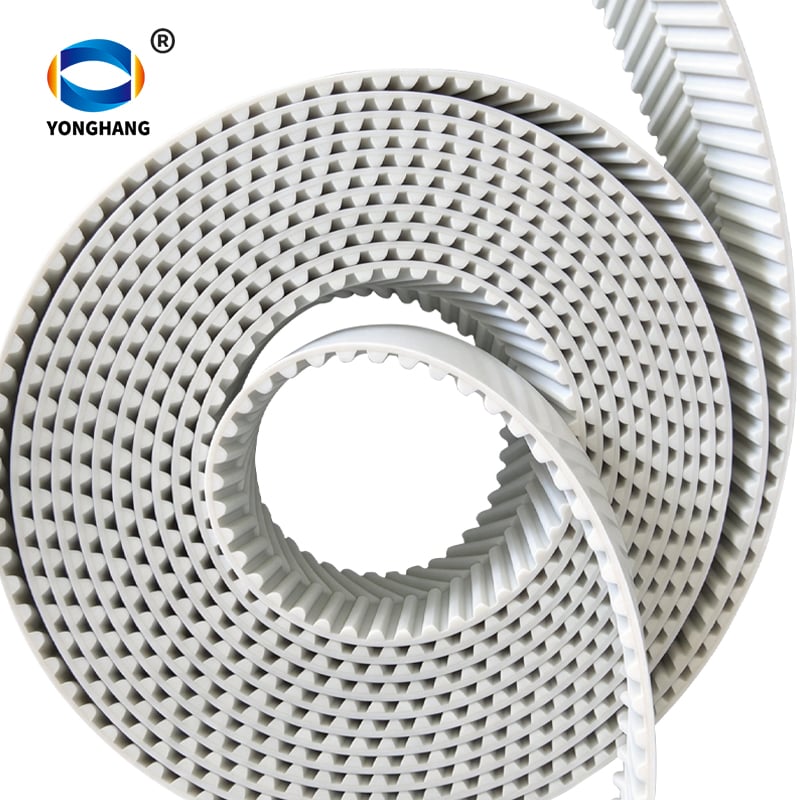
If you have ever stood next to a running conveyor or CNC machine and noticed a high-pitched whine, rhythmic clicking, or visible belt tracking issues, you have experienced the inherent limitations of standard straight-tooth timing belts. For decades, straight-tooth synchronous belts have been the default choice for industrial power transmission — but today, more and more manufacturers are upgrading to open ended herringbone timing belts to solve these exact problems.
In this article, we compare herringbone (double helical) and straight-tooth timing belts across six critical performance metrics and explain why the herringbone design delivers measurable improvements in noise, vibration, durability, and overall system cost.
The Straight-Tooth Baseline: Where Standard Belts Fall Short
Straight-tooth timing belts (including HTD, STD, and T-profile designs) have served industry well for many years. Their simple, perpendicular tooth geometry is easy to manufacture and works adequately for many general-purpose applications. However, they suffer from several fundamental design limitations:
- Impact noise: Each tooth engages the pulley groove all at once, creating a sharp impact that generates audible noise and vibration
- Axial thrust: Straight teeth produce lateral forces that push the belt toward one side, requiring pulley flanges and causing edge wear
- Lower contact ratio: Fewer teeth are engaged at any given moment, concentrating load on a small number of tooth surfaces
- Higher backlash: Sudden tooth engagement can create positioning inaccuracies in high-precision systems
These limitations become more pronounced as speed and load increase. For high-performance machinery, the noise, vibration, and premature wear add up to higher maintenance costs and reduced equipment lifespan.
How Herringbone Tooth Design Solves These Problems
A herringbone timing belt features teeth arranged in a symmetrical V-shaped (double helical) pattern, named for its resemblance to the bones of a herring. This seemingly simple geometric change transforms belt performance across every key metric.
1. Noise Reduction: Up to 11 dB Quieter Operation
This is the most immediately noticeable difference. With straight teeth, each tooth slams into the pulley groove simultaneously across the full belt width, creating an impact pulse that repeats with every tooth pitch. The herringbone design changes this entirely — each tooth engages gradually, starting from one edge and progressing smoothly across the belt width.
Independent testing shows that properly engineered herringbone belts reduce meshing noise by 6–11 decibels compared to equivalent straight-tooth belts under identical conditions. At high linear speeds (above 10 m/s), the difference is dramatic enough to eliminate the need for acoustic enclosures in some applications. This is not just a comfort issue — lower noise means lower mechanical stress and longer component life.
2. Natural Self-Tracking: No More Edge Wear
One of the biggest maintenance headaches with straight-tooth belts is lateral tracking drift. Straight teeth generate axial thrust forces that push the belt sideways, requiring flanged pulleys and causing constant friction between the belt edge and flange. Over time, this wears down the belt edges and can lead to premature failure.
Herringbone belts solve this through geometry alone. The symmetrical double helical tooth pattern creates equal and opposite axial forces that cancel each other out perfectly. The belt naturally runs centered on the pulley without the need for side flanges. The result: zero edge wear, simpler and cheaper pulley design, and longer belt service life.
3. Smoother Motion & Lower Vibration
The gradual tooth engagement of the herringbone design also means a higher effective contact ratio — more teeth are sharing the load at any given moment. This distributes power transfer more evenly, reducing tooth root stress and minimizing vibration throughout the drive system.
For precision applications like CNC machinery, printing presses, and inspection equipment, this smoother motion translates directly into better positioning accuracy, lower backlash, and higher-quality output. Material handling systems run with less product shifting, and high-speed processes operate with greater stability.
4. Longer Service Life
Because herringbone belts reduce impact stress, eliminate edge friction, and distribute load across more teeth, they simply last longer. The reduction in mechanical fatigue means fewer tooth cracks, less surface wear, and longer intervals between replacements.
When combined with high-quality PU material and steel cord reinforcement, premium herringbone belts from Yonghang deliver an average of 30% longer service life compared to standard straight-tooth alternatives in comparable applications.
5. Cleaner, Maintenance-Free Operation
Like all synchronous belts, herringbone belts require no lubrication — unlike chain drives. But because they run without flange friction and produce less wear debris, they are also cleaner than straight-tooth belts. This makes them preferred for packaging, food processing, and electronics manufacturing where contamination must be minimized.
6. Lower Total System Cost
While herringbone belts may have a slightly higher upfront purchase price, they deliver lower total cost of ownership through:
- Longer service intervals reducing replacement costs
- Elimination of pulley flanges reducing component costs
- Lower vibration reducing bearing and pulley wear
- Quieter operation reducing or eliminating sound insulation requirements
- Fewer unplanned downtime events
The Open Ended Advantage: Flexible Lengths for Every Application
When herringbone tooth geometry is combined with an open-ended roll format, you get the best of both worlds: premium performance and maximum installation flexibility.
Open ended herringbone timing belts are supplied in continuous rolls (typically 50m or 100m) and cut to exact required lengths on site. This means:
- No length limitations: Perfect for very long center distances and custom gantry systems
- On-demand fabrication: Cut and weld only what you need, reducing inventory
- Easy retrofitting: Upgrade existing straight-tooth systems without redesigning the entire drive
- Reduced waste: No need to stock dozens of pre-molded endless lengths
The open ends can be thermally welded into seamless endless loops using standard PU belt welding equipment, creating a strong, dimensionally consistent joint for rotary drive applications.
Industries Seeing the Biggest Improvements
CNC & Automation
Laser cutters, engraving machines, and gantry robots gain better cut quality and quieter workshop environments. The self-tracking property also reduces setup and alignment time.
Printing & Packaging
Folder gluers, web presses, and form-fill-seal machines achieve more precise registration and lower noise on the production floor.
Cable & Pipe Extrusion
Long-center-distance haul-off machines benefit from the high tensile strength of steel-cord 14M herringbone belts and their smooth, consistent pulling force.
Material Handling
Synchronous conveyor systems run quieter with less product vibration, improving sorting accuracy and reducing workplace noise exposure.
Yonghang Open Ended Herringbone Belt Range
Yonghang Transmission Belt manufactures a complete range of open ended herringbone timing belts in four standard pitches: 5M, 8M, 10M, and 14M. All belts are extruded from premium thermoplastic polyurethane and reinforced with continuous high-tensile steel cords, with aramid cord options available.
With our in-house CNC machining, water jet cutting, coating and grinding capabilities, we can fully customize every belt — from custom width slitting to drilled holes, special coatings, and cleat attachments.
Is It Time to Upgrade?
If your current straight-tooth belt system suffers from excessive noise, tracking issues, frequent replacements, or vibration-related quality problems, upgrading to open ended herringbone timing belts is one of the highest-ROI improvements you can make. The performance gains are measurable, and the total cost savings typically justify the upgrade quickly.
Want to evaluate whether herringbone belts are right for your equipment? Reach out to our technical team for a free application review — we will help you identify the right pitch, width, and cord material for your specific requirements.