
 EN
EN
 AR
AR
 HR
HR
 DA
DA
 NL
NL
 FR
FR
 DE
DE
 EL
EL
 HI
HI
 IT
IT
 JA
JA
 KO
KO
 NO
NO
 PL
PL
 PT
PT
 RO
RO
 RU
RU
 ES
ES
 TL
TL
 IW
IW
 ID
ID
 SR
SR
 SK
SK
 UK
UK
 VI
VI
 TH
TH
 TR
TR
 AF
AF
 MS
MS
 IS
IS
 HY
HY
 AZ
AZ
 KA
KA
 BN
BN
 LA
LA
 MR
MR
 MY
MY
 KK
KK
 UZ
UZ
 KY
KY
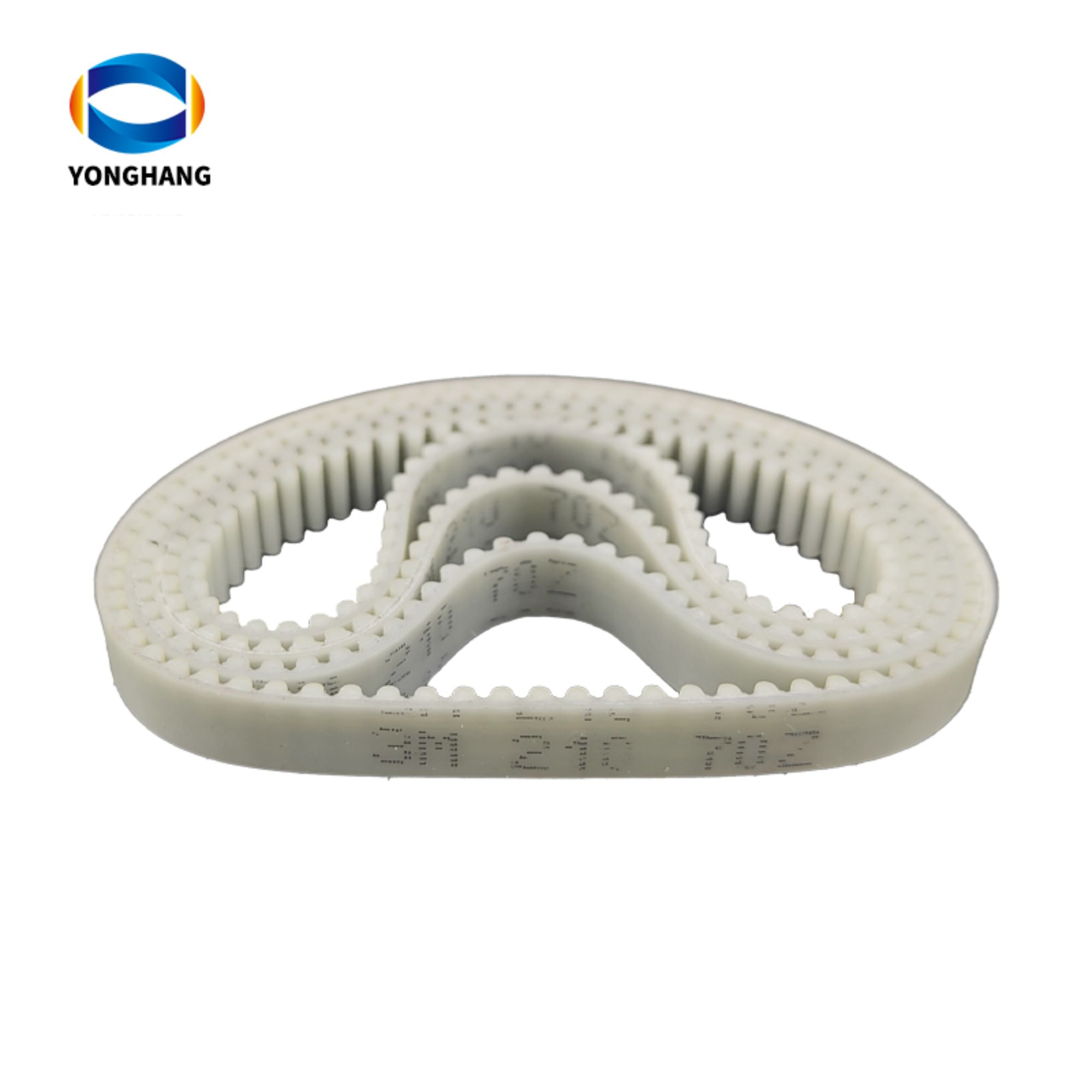
Material Science Foundations: PU Timing Belt vs. Rubber Belt Chemistry
Thermoplastic Polyurethane Structure and Processing Advantages
Timing belts made from thermoplastic polyurethane (TPU) have a special structure where rigid parts alternate with flexible sections in their polymer chains. What makes these belts stand out is how well they keep their stretchiness over time, with tensile strength often going beyond 50 MPa. Compared to traditional vulcanized rubber, working with TPU doesn't require those chemical cross-linkers during processing. Manufacturers can simply extrude or inject mold the material, which cuts down on production time by around 40% and gets pretty close to final shape right away (within about 0.1 mm). Without needing those lengthy curing steps, there's much less variation between batches that plagues rubber manufacturing, so every belt tooth ends up looking consistent enough for accurate power transfer. Plus, since TPU is a thermoplastic material, any leftover scraps from production can be fully recycled back into new products, helping factories meet sustainability targets while keeping costs under control.
Vulcanized Rubber Systems: Natural, SBR, CR, and Their Limitations
Rubber belts made through vulcanization processes include materials like natural rubber (NR), styrene-butadiene rubber (SBR), and chloroprene rubber (CR). These materials rely on sulfur cross linking that creates those tough three-dimensional networks we all know about. But there's a catch. The same process that gives them good tear resistance also brings some serious problems. Take natural rubber for instance it breaks down pretty fast when exposed to ozone, losing around 30% of its strength within just 500 hours. Then there's SBR which can swell by as much as 25% when it gets contaminated with oil. Chloroprene rubber seems okay against oils at first glance, but gets really brittle once temperatures drop below minus 20 degrees Celsius. And let's not forget about those inconsistent curing rates throughout different parts of the belt profile. This leads to all sorts of issues with how much they stretch when put under stress, ultimately causing them to fail prematurely especially in harsh chemical environments such as those found in chemical processing facilities.
Performance Metrics: Wear, Chemical, and Thermal Resistance of PU Timing Belt
Abrasion Resistance and Service Life Under Dynamic Load
Polyurethane timing belts last about three times longer than their rubber counterparts when dealing with those tough high friction situations and dynamic loads. This has been confirmed through standard tests like ISO 527-2 for tension and ASTM D395 for compression resistance. When installed in CNC machining centers, these belts keep their teeth intact well past the 15,000 hour mark in most cases. The way PU molecules stick together means they shed only about a quarter as much debris during heavy load periods compared to other materials. Rubber belts tend to develop cracks when exposed to around 60 newtons per square millimeter of stress, but polyurethane stays strong, keeping roughly 95% of its initial strength even after similar amounts of wear and tear. For manufacturers running automated assembly lines, this means far fewer belt replacements over time, which saves both money and downtime.
Oil, Solvent, UV, and Oxidation Resistance in Harsh Industrial Environments
Polyurethane timing belts work really well in environments where chemicals are everywhere, like in drug production lines and food factories. They just don't react much to stuff like hydrocarbons, organic acids, or even UV light. When put through tests with ASTM Oil No. 3 for 500 straight hours, PU only swells by about 2% in volume compared to those old CR rubber belts which can bloat up between 15-20%. What's more, these belts stay pliable across a pretty wide temperature range from minus 30 degrees Celsius all the way up to 80 degrees. Most rubber options start getting stiff when temps drop below minus 10 or get all gooey once it hits 70 plus. And let's not forget about ozone resistance either. After being exposed to ozone for extended periods, PU still keeps around 90% of its original stretch capability before breaking. That means no hardening or cracking issues that tend to ruin rubber alternatives over time.
| Resistance Metric | PU Timing Belt Performance | Rubber Belt Performance |
|---|---|---|
| Abrasion | <25% wear after 10k hours | >60% wear after 10k hours |
| Oil/Solvent | <2% volume swell | 15–20% volume swell |
| UV Degradation | Retains 90% flexibility | Loses 40% flexibility |
| Thermal Range | −30°C to 80°C | −10°C to 70°C |
Precision Engineering: Tensile Strength, Elongation Control, and Backlash Minimization
How PU Timing Belt Delivers Superior Dimensional Stability in High-Accuracy Motion
The dimensional stability of PU timing belts in precision motion systems comes down to three key design features that set them apart. First off, the thermoplastic polyurethane material offers much better tensile strength compared to traditional vulcanized rubber options, typically around 15 to 25 percent stronger actually. This helps prevent those annoying permanent deformations when the belt is subjected to dynamic loads over time. Looking at the second advantage, these belts have been engineered so their elongation stays really tight control, usually below 0.3% when operating under normal tension levels. That means almost no positional drift happens during those rapid direction changes, which matters a lot in applications where backlash needs to stay well under 0.1 degrees like in robotic arms or CNC machines. The third factor involves those specially molded teeth on the belt itself. They fit together with sprockets so cleanly that there's practically no micro-slip occurring, something that would otherwise accumulate into significant positioning errors over time. According to tests following ISO 5296:2021 standards, PU timing belts maintain their dimensional accuracy within about 5 microns even after running continuously for over 500 hours straight. That kind of performance beats standard rubber alternatives by roughly 40%, making them particularly valuable in delicate operations such as semiconductor wafer handling. When combined with those reinforced fiber cords and the inherent molecular consistency of PU materials, we get belts with practically zero hysteresis effects, allowing for extremely repeatable motion transfers at submicron levels.
Real-World Application Fit: Where PU Timing Belt Outperforms Traditional Belts
CNC Machines, Packaging Lines, and Semiconductor Equipment Case Evidence
Timing belts made from polyurethane offer real improvements in reliability for applications where failure isn't an option. Take semiconductor wafer handling as an example these belts have almost no backlash (around 0.1 mm or less), which keeps those ultra-fine alignments intact in cleanrooms where regular rubber belts would wear out fast. On packaging lines, companies have seen about a 70% drop in problems related to timing when they switched to PU belts. This is especially noticeable at high speed filling stations where maintaining proper tension stops spills and keeps production running smoothly. Tests show CNC machining centers can run for well over 15,000 hours before needing replacement, saving manufacturers roughly $740k per year on maintenance according to research from Ponemon Institute back in 2023. Another big plus is how PU stands up against coolant leaks and tiny abrasions caused by metal particles something that causes ordinary rubber belts to fail completely within just a few months.
FAQ
What are the main advantages of PU timing belts over rubber belts?
PU timing belts offer superior performance in terms of abrasion resistance, oil and solvent resistance, UV degradation tolerance, and thermal range adaptability compared to rubber belts.
How does PU timing belt processing compare to that of rubber belts?
PU timing belts require less complex processing than rubber belts, as they don't need chemical cross-linkers and can be extruded or molded more efficiently, reducing production time by about 40%.
In what environments do PU timing belts excel?
PU timing belts excel in harsh industrial environments that involve chemicals, oil, solvents, UV light, and extreme temperatures, making them ideal for use in drug production lines and food factories.
Are PU timing belts recyclable?
Yes, since TPU is a thermoplastic material, leftover scraps from PU belt production can be fully recycled into new products, supporting sustainability goals.
How do PU timing belts perform in precision motion systems?
PU timing belts maintain superior dimensional stability, exhibit tight elongation control, minimal backlash, and significantly reduce micro-slip in precision motion systems.
Table of Contents
- Material Science Foundations: PU Timing Belt vs. Rubber Belt Chemistry
- Performance Metrics: Wear, Chemical, and Thermal Resistance of PU Timing Belt
- Precision Engineering: Tensile Strength, Elongation Control, and Backlash Minimization
- Real-World Application Fit: Where PU Timing Belt Outperforms Traditional Belts
- FAQ