
 EN
EN
 AR
AR
 HR
HR
 DA
DA
 NL
NL
 FR
FR
 DE
DE
 EL
EL
 HI
HI
 IT
IT
 JA
JA
 KO
KO
 NO
NO
 PL
PL
 PT
PT
 RO
RO
 RU
RU
 ES
ES
 TL
TL
 IW
IW
 ID
ID
 SR
SR
 SK
SK
 UK
UK
 VI
VI
 TH
TH
 TR
TR
 AF
AF
 MS
MS
 IS
IS
 HY
HY
 AZ
AZ
 KA
KA
 BN
BN
 LA
LA
 MR
MR
 MY
MY
 KK
KK
 UZ
UZ
 KY
KY
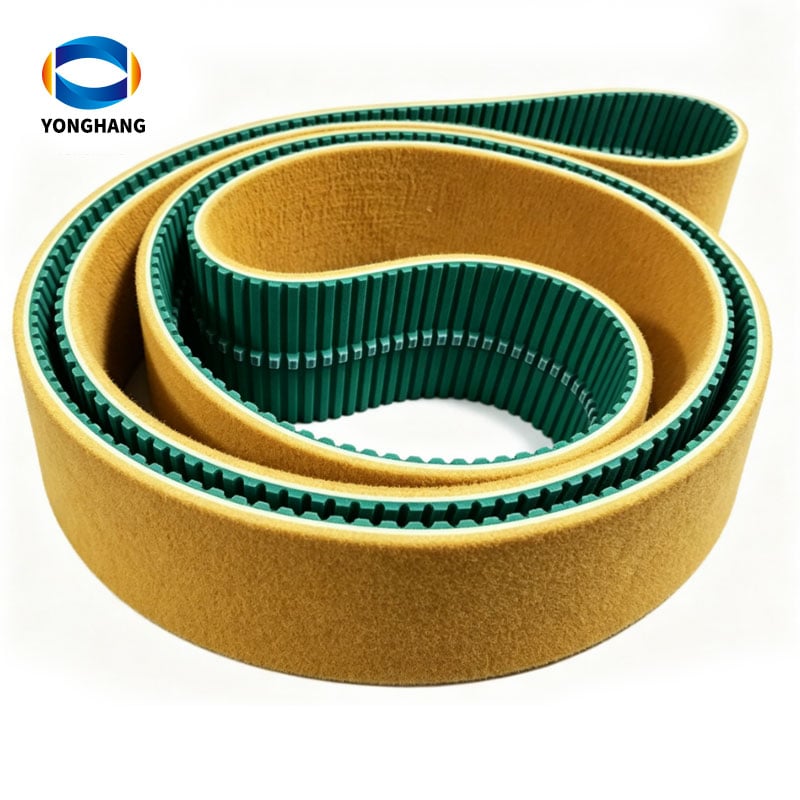
When conventional conveyor belts or standard timing belts are exposed to extreme heat, maintaining reliable transmission is only part of the challenge. The belt surface must also protect the workpiece from heat damage, scratches, scorching, and other surface defects.
A 600°C POB felt coated PU timing belt is designed for this type of demanding environment. It combines the synchronous transmission characteristics of a polyurethane timing belt with a heat-resistant POB felt contact layer. The result is a customized composite belt designed for automated equipment operating in high-temperature thermal processing environments.
This article explains how a POB felt coated PU timing belt works, why the felt layer is important, what the 600°C specification means, how to select the belt, and where this type of belt can be used.
Key Facts at a Glance
| Feature | Product Specification |
|---|---|
| Belt Type | PU Timing Belt with POB Felt Coating |
| Coating Material | POB Felt |
| Maximum Working Temperature | Up to 600°C |
| Felt Thickness | 6 mm / 8 mm |
| Minimum Pulley Diameter | 30 × total coating thickness |
| Coating Color | Brown |
| Main Features | High-temperature resistance, cut resistance |
| Belt Structure | PU timing belt + bonded POB felt layer |
| Customization | Tooth profile, belt width, endless length, felt thickness |
| Typical Applications | High-temperature furnaces, thermal processing equipment, metal processing and sintering lines |
The specifications above follow the current product information published for Yonghang's 600°C POB felt coated PU timing belt.
What Is a 600°C POB Felt Coated PU Timing Belt?
A POB felt coated PU timing belt is a composite transmission belt made from two functional parts.
The first part is the PU timing belt base. Its toothed profile engages with a matching timing pulley and provides synchronous mechanical transmission.
The second part is the POB felt coating. This heat-resistant surface is designed to contact or support workpieces in high-temperature production environments.
Instead of asking one material to perform every function, the composite construction separates the transmission function from the high-temperature contact function.
This is particularly useful when a machine needs both:
-
precise synchronous movement;
-
and protection of the workpiece from extreme heat.
The product is therefore more than a simple timing belt and more than a conventional felt conveyor belt. It is a specialized high-temperature synchronous transmission solution.
Why Combine a PU Timing Belt with POB Felt?
A timing belt and a high-temperature contact surface have different jobs.
The PU timing belt provides the mechanical foundation for synchronized movement. Its teeth engage with the pulley to control belt travel and positioning.
The felt layer performs a different role. It creates a protective interface between the belt and the processed material while helping the belt surface withstand severe thermal conditions.
This combination can be particularly useful in automated thermal processing equipment where a workpiece must be moved through a hot zone while maintaining stable positioning.
The design can be understood in three simple layers of functionality:
Timing teeth → synchronized movement
PU belt body → mechanical transmission
POB felt surface → high-temperature contact and workpiece protection
This functional separation is one of the most important characteristics of a coated timing belt for extreme-temperature applications.
How Does the 600°C POB Felt Layer Protect the Workpiece?
High-temperature processing can create several problems for a conventional belt surface.
Direct exposure to intense heat may cause scorching, burn marks, surface damage, or other unwanted marks on the processed material. Mechanical contact can create another issue: scratches or surface defects.
The POB felt coating is designed to form a heat-resistant contact barrier.
According to the product specification, the felt surface is intended to provide thermal shielding while protecting workpieces from scorching, ablation, burn marks, and mechanical scratches.
This makes the felt layer especially valuable when the material being transported cannot tolerate aggressive contact with a conventional hard surface.
For automated equipment, the objective is not simply to move a product. The objective is to move it reliably without compromising the finished surface.
Does a 600°C Rating Mean the PU Belt Itself Operates Like a Metal Belt at 600°C?
This is an important technical distinction.
The product is specified as a PU timing belt with a 600°C POB felt coating, and the product page lists a maximum working temperature of +600°C for the coating specification.
In actual machine design, however, temperature exposure should always be evaluated according to the complete belt construction, heat-transfer method, contact time, bending conditions, pulley arrangement, and machine configuration.
A 600°C coating specification should therefore not be interpreted as meaning that every part of a complete transmission system experiences identical thermal conditions at 600°C.
For a new machine or a particularly severe application, the belt manufacturer should confirm the appropriate construction based on the actual temperature profile and operating cycle.
Why Synchronous Transmission Matters in High-Temperature Machinery
Many high-temperature applications require more than simple conveying.
The belt may need to move components into a thermal chamber, transfer parts between processing stations, or synchronize repeated production cycles.
In those situations, uncontrolled belt slip can affect:
-
workpiece positioning;
-
processing time;
-
machine synchronization;
-
repeatability;
-
production efficiency.
A toothed timing belt addresses the transmission side of the problem through positive engagement between the belt teeth and the pulley.
The coated surface then handles the workpiece-contact requirement.
That is why this type of belt can be useful when both synchronous motion and high-temperature surface protection are required.
What Are the Advantages of POB Felt Coating?
1. High-temperature surface performance
The coating is designed for extreme-temperature applications, with the product specification listing a maximum working temperature of +600°C.
2. Thermal shielding
The felt surface acts as a protective barrier between the belt structure and the processed workpiece.
3. Reduced risk of surface damage
The product is designed to provide a softer, non-damaging contact surface than a hard transmission surface, which can be valuable for sensitive workpieces.
4. Cut resistance
The published specification identifies the coating as resistant to cutting.
5. Synchronous movement
The PU timing belt base maintains toothed engagement with the pulley for controlled transmission.
6. Composite construction
A specialized bonding process is used to attach the felt to the timing belt substrate. The product page describes the construction as being designed to tolerate thermal shock, cyclic temperature changes, and repeated bending without delamination.
6mm or 8mm POB Felt: Which Thickness Should You Choose?
The product is currently specified with 6mm and 8mm POB felt thickness options.
Choosing between them should not be based on thickness alone.
The correct choice depends on the machine's:
-
workpiece temperature;
-
contact pressure;
-
surface condition;
-
bending radius;
-
belt path;
-
pulley dimensions;
-
cycle frequency;
-
required cushioning effect;
-
actual thermal exposure.
A thicker felt layer may be suitable when greater surface protection or additional contact material is required, while a thinner layer may be preferable where the mechanical geometry is more restrictive.
The final belt construction should be selected according to the complete operating environment rather than one specification in isolation.
Minimum Pulley Diameter Is an Important Design Parameter
The product specification lists a minimum pulley diameter of 30 × the coating thickness.
This is especially important for coated belts because the coating changes the overall mechanical behavior of the belt assembly.
For example, when the POB felt is 6mm thick, a simple dimensional check gives:
Minimum pulley diameter = 30 × 6mm = 180mm
For an 8mm felt coating:
Minimum pulley diameter = 30 × 8mm = 240mm
These values are useful as initial design references, but the complete machine geometry should still be reviewed before final belt selection.
Where Are 600°C POB Felt Coated PU Timing Belts Used?
This type of composite timing belt is intended for specialized industrial environments where heat, synchronized motion, and surface protection must be considered together.
The product page specifically describes applications including:
High-Temperature Furnaces
Automated furnace equipment may require a belt to transfer products through high-temperature zones while maintaining controlled movement.
Thermal Processing Equipment
Thermal processing systems often require repeatable movement between different stages of a production cycle.
Metal Thermal Processing
Metal-related processing environments can expose conveyor surfaces to intense heat and demanding mechanical conditions.
Special-Material Sintering Lines
Sintering processes can involve elevated temperatures and require controlled material handling.
Automated High-Temperature Production Lines
Where robotic or automated equipment moves parts through a thermal process, a synchronous belt can help maintain positional accuracy while the coated surface provides a heat-resistant contact interface.
These application categories are based on the current product description published by Yonghang.
What Types of Workpieces Benefit from Felt-Coated Timing Belts?
A felt-coated timing belt is especially relevant when the workpiece itself is a critical part of the application.
For example, the belt may be transporting:
-
heat-processed components;
-
materials requiring careful surface handling;
-
parts that can be scratched by hard conveyor surfaces;
-
products moving through thermal treatment;
-
components requiring stable positioning during heating.
The important consideration is not simply how hot the machine is.
The better question is:
What happens to the workpiece when it contacts the belt at operating temperature?
If the answer involves risk of scratching, burning, marking, or surface contamination, the contact layer becomes a major part of the belt-selection decision.
POB Felt Coating vs. Standard Timing Belt Surface
A standard timing belt is mainly selected for its transmission characteristics.
A POB felt coated timing belt is selected when the belt has to perform additional work at the contact surface.
| Requirement | Standard Timing Belt | POB Felt Coated Timing Belt |
|---|---|---|
| Synchronous transmission | Yes | Yes |
| Toothed pulley engagement | Yes | Yes |
| High-temperature contact | Limited by belt construction | Specifically designed for extreme-temperature applications |
| Workpiece surface protection | Limited | Major design objective |
| Felt contact layer | No | Yes |
| Thermal shielding | Limited | Yes |
| Custom felt thickness | No | 6mm / 8mm specified, with customization available |
| Extreme thermal processing | Application dependent | Designed for specialized high-temperature equipment |
The comparison highlights an important point: the felt-coated version is not simply a thicker timing belt. It is a different functional belt solution.
How Is the POB Felt Attached to the PU Timing Belt?
Bonding quality is critical in any coated timing belt.
If the surface coating separates from the timing belt substrate, the belt may no longer provide the intended contact performance.
The product page states that Yonghang uses a special high-temperature composite bonding process to secure the POB felt to the PU timing belt. The construction is described as resistant to thermal shock, temperature cycling, and repeated bending loads, with the aim of reducing delamination or layer separation during service.
For this reason, coating adhesion should be treated as a key specification when comparing suppliers.
Can the Timing Belt Be Customized?
Yes.
Customization is one of the important features of this product.
The published specification indicates support for customization of:
-
tooth profile;
-
belt width;
-
endless loop circumference;
-
POB felt thickness.
This allows the belt to be matched to specific machine dimensions rather than forcing the equipment designer to adapt the machine to a standard belt size.
For custom orders, it is useful to provide the belt supplier with as much machine information as possible.
Recommended information includes:
Belt tooth profile: HTD, T, AT, or other required profile
Belt width: required finished width
Endless length: required loop circumference
POB felt thickness: 6mm, 8mm, or a customized thickness
Pulley diameter: especially important for coated belt applications
Operating temperature: actual process temperature, not only the chamber temperature
Contact condition: pressure, workpiece shape, and surface characteristics
Running speed: continuous or intermittent operation
The more complete the application information, the easier it is to create a belt suitable for the machine.
How to Choose the Right 600°C POB Felt Coated Timing Belt
A practical selection process can be divided into six steps.
Step 1: Confirm the temperature
Determine the actual temperature at the belt contact point.
Do not rely only on the rated temperature of the furnace or heating chamber.
Step 2: Confirm the belt profile
The timing tooth profile must match the pulley.
Step 3: Check pulley diameter
Make sure the belt construction is compatible with the pulley geometry. For this product, the published minimum pulley diameter is 30 times the coating thickness.
Step 4: Select the felt thickness
Choose between the standard 6mm and 8mm options or discuss a customized thickness based on the contact requirements.
Step 5: Evaluate the workpiece
Consider whether the product can tolerate hard contact, friction, heat exposure, and repeated surface contact.
Step 6: Confirm the complete operating cycle
Temperature, speed, bending, load, pulley size, exposure time, and duty cycle should be considered together.
This approach is much more reliable than selecting a belt simply by width or temperature rating.
Maintenance Considerations for High-Temperature Felt Coated Timing Belts
Even a specialized high-temperature belt requires appropriate operating conditions.
Regular inspection should focus on:
-
felt surface wear;
-
visible cuts;
-
abnormal compression;
-
coating separation;
-
damage near the belt edges;
-
tooth wear;
-
unusual tracking behavior;
-
changes in belt tension;
-
surface contamination.
A small surface defect should not automatically be treated as a belt failure. However, progressive delamination, significant felt damage, or damaged timing teeth should be investigated before the belt continues operating in a high-temperature production line.
Preventive inspection is particularly valuable in automated equipment because an unexpected belt failure can interrupt an entire thermal processing cycle.
Common Questions About 600°C POB Felt Coated PU Timing Belts
What is a POB felt coated timing belt?
It is a polyurethane timing belt fitted with a heat-resistant POB felt surface. The timing belt provides synchronous transmission while the felt layer provides a high-temperature contact and protective surface.
What temperature can the belt handle?
The product specification lists a maximum working temperature of +600°C for the POB felt coating. Actual application limits should be confirmed based on the complete belt construction and machine operating conditions.
What thicknesses are available?
The published standard coating thicknesses are 6mm and 8mm, with customized felt thickness also available for specific requirements.
What is the minimum pulley diameter?
The product specification lists the minimum pulley diameter as 30 times the coating thickness.
Can the belt be made endless?
Yes. The product description states that endless loop circumference can be customized according to the machine requirements.
Can the tooth profile be customized?
Yes. Custom tooth profiles are available, which makes the belt suitable for different timing-belt pulley systems.
What industries use this type of belt?
Typical applications include high-temperature furnaces, thermal processing equipment, metal thermal processing, special-material sintering lines, and other automated manufacturing systems exposed to extreme heat.
Is this belt suitable for protecting delicate workpieces?
The POB felt contact layer is specifically designed to provide a gentler contact surface and reduce the risk of scorching, burn marks, and mechanical surface damage. The suitability of the final belt should still be confirmed against the actual workpiece and process conditions.
Why Choose a Customized POB Felt Coated Timing Belt?
High-temperature machinery rarely has identical working conditions from one application to another.
Two machines may operate at similar temperatures but use different pulley diameters, belt widths, cycle speeds, workpiece shapes, and contact pressures.
That is why a customized composite belt can be more practical than a generic high-temperature conveyor solution.
The goal is to match four major functions:
Precision: the timing profile must match the drive system.
Protection: the felt surface must suit the workpiece.
Thermal performance: the coating must be appropriate for the temperature cycle.
Geometry: belt length, width, pulley diameter, and coating thickness must fit the machine.
When these factors are considered together, the belt becomes part of the machine's thermal-processing system rather than simply a replaceable conveyor component.
Final Takeaway
A 600°C POB felt coated PU timing belt is designed for applications where ordinary transmission belts are not enough.
Its value comes from the combination of two functions: the PU timing belt provides synchronized mechanical transmission, while the POB felt coating provides a high-temperature contact surface designed to shield and protect workpieces.
With standard 6mm and 8mm felt options, a published +600°C maximum working-temperature specification, a minimum pulley diameter based on coating thickness, and customization of tooth profile, belt width, endless length, and felt thickness, this belt can be configured for demanding thermal processing equipment.
For engineers and purchasing teams, the most important selection criteria are not temperature alone. The complete application should be evaluated, including pulley diameter, belt profile, felt thickness, actual contact temperature, workpiece characteristics, operating cycle, and belt geometry.
When precise synchronous movement and high-temperature workpiece protection are required in the same machine, a POB felt coated PU timing belt offers a specialized way to combine both functions.
Table of Contents
- Key Facts at a Glance
- What Is a 600°C POB Felt Coated PU Timing Belt?
- Why Combine a PU Timing Belt with POB Felt?
- How Does the 600°C POB Felt Layer Protect the Workpiece?
- Does a 600°C Rating Mean the PU Belt Itself Operates Like a Metal Belt at 600°C?
- Why Synchronous Transmission Matters in High-Temperature Machinery
- What Are the Advantages of POB Felt Coating?
- 6mm or 8mm POB Felt: Which Thickness Should You Choose?
- Minimum Pulley Diameter Is an Important Design Parameter
- Where Are 600°C POB Felt Coated PU Timing Belts Used?
- What Types of Workpieces Benefit from Felt-Coated Timing Belts?
- POB Felt Coating vs. Standard Timing Belt Surface
- How Is the POB Felt Attached to the PU Timing Belt?
- Can the Timing Belt Be Customized?
- How to Choose the Right 600°C POB Felt Coated Timing Belt
- Maintenance Considerations for High-Temperature Felt Coated Timing Belts
-
Common Questions About 600°C POB Felt Coated PU Timing Belts
- What is a POB felt coated timing belt?
- What temperature can the belt handle?
- What thicknesses are available?
- What is the minimum pulley diameter?
- Can the belt be made endless?
- Can the tooth profile be customized?
- What industries use this type of belt?
- Is this belt suitable for protecting delicate workpieces?
- Why Choose a Customized POB Felt Coated Timing Belt?
- Final Takeaway